



Bachelor of Science in Cybersecurity
Expand your career opportunities in tech and serve organizations with integrity.
Get Started Today
Ready to learn more about Concordia University Irvine?
Complete this form, and an admissions counselor will connect with you.
"*" indicates required fields
Defend Vulnerable Info. Restore Exploited Data.
Prepare to confront today’s digital threats with a Bachelor of Science in Cybersecurity from Concordia University Irvine.
As a cybersecurity major, you’ll uncover vulnerabilities, evaluate risks, strengthen defenses, and respond to security incidents. You’ll learn to think like an attacker, act like a defender, and make wise decisions when security, cost, and practical realities collide. In doing so, you’ll discover that cybersecurity goes beyond protecting computers to protecting the people and communities who depend upon them.
Grounded in a Lutheran, Christian liberal arts education, the cybersecurity program at Concordia prepares you to be a skilled technical professional who knows how to approach complex problems with wisdom and exercise honorable judgment in protecting others. Inspired by Christ’s words, “I came that they may have life and have it abundantly” (John 10:10), you’ll learn to cultivate a deeper understanding of how your work can serve your neighbors and help them go about their lives with greater security and peace of mind.

Career Relevant
Gain real-world skills for a life of service and leadership.

Collaborative Classes
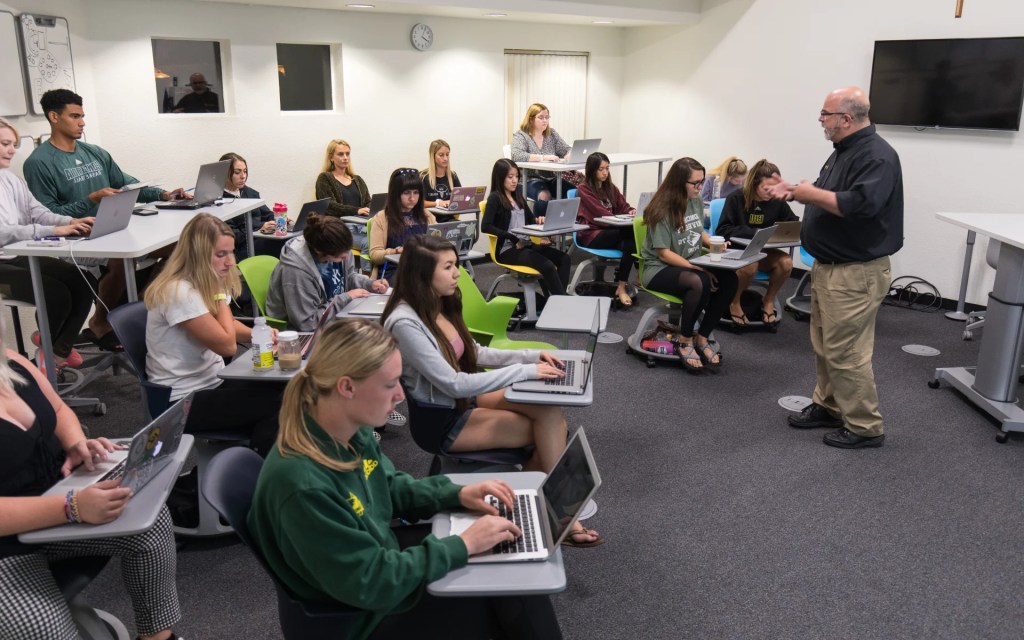
Learn in classes with a 15:1 student-to-faculty ratio.

Caring Community
Discover your second home on our beautiful campus.
Concordia is preparing me for my callings by challenging me every day. My classes are challenging and push me every day, but have trained me to exercise my responsibility and time management skills.
Veronica P. ’25

Getting Started
Cybersecurity majors at Concordia develop investigative thinking, technical precision, sound judgment, and practical problem-solving skills through hands-on experience in physical and virtual laboratories. Working with real equipment and simulated environments, you’ll learn to connect theoretical concepts with the complexities of real-world systems.
Building on a foundation of computing and networking, our cybersecurity curriculum is organized around four pillars, each representing a different approach to protecting people and the systems they depend on:
- Defensive Thinking: Identifying vulnerabilities, proposing mitigations, and hardening systems against attack.
- Investigative Thinking: Investigating suspicious activity and analyzing evidence to uncover security weaknesses and determine what happened.
- Restorative Thinking: Responding to security incidents, containing damage, and restoring compromised systems.
- Strategic Thinking: Evaluating risks and developing practical security policies that balance protection, cost, and operational needs.
Through collaborative projects and realistic challenges in our cyber range, you’ll put these four approaches to cybersecurity into practice. Along the way, you’ll develop the technical expertise, adaptability, and professional judgment needed for careers in cybersecurity or advanced study in the field.
Curriculum
Core Curriculum (Sample Courses):
- CSC104 – Fundamentals of Programming
- CSC105 – Web Design
- CSC128 – Introduction to Cybersecurity
- CSC210 – Introduction to Operating Systems
- CSC212 – Data Structures
- CSC316 – Introduction to Networking
- CSC318 – Object-Oriented Programming
- CSC320 – Databases and Server-Side Development
- CSC322 – Software Engineering
- CSC338 – Secure Systems Administration
- CSC348 – Rootkits and Malware Analysis
- CSC358 – Security and Penetration Testing
- CSC428 – Information Security
- CSC468 – Ethics, Threats, and Risks
- CSC478 – Advanced Security Defense
- MTH265 – Introduction to Statistics
- MTH271 – Calculus I
- MTH376 – Discrete Mathematics
Program Learning Outcomes
Upon completion of the cybersecurity program, you will be equipped to:
- Investigate, design, implement, and evaluate secure systems and defensive measures that protect computing resources, mitigate vulnerabilities, restore compromised systems, and meet specified security requirements.
- Apply algorithmic, mathematical, and scientific reasoning to a variety of complex computing problems.
- Analyze, articulate, and apply scholarly resources to integrate technical theory, operational data, and best practices in support of justified decisions and anticipation of emerging threats.
- Cultivate the Christian teaching of vocations to make wise, informed judgments and practice ethical, honorable decision-making in cybersecurity.
- Demonstrate effective written and oral communication skills in cybersecurity.
- Function effectively as a gracious and helpful member or leader of a team.
Program Educational Objectives
Program Educational Objectives (PEOs) describe the professional accomplishments that graduates are expected to achieve within five years of completing the program. Accomplishments for cybersecurity graduates include:
- Build a professional foundation in industry, government, nonprofit organizations, or academia that leads to a stable career with strong potential for growth.
- Strengthen the security and resilience of organizations by anticipating threats, improving defenses, investigating incidents, restoring compromised systems, and making wise decisions about cybersecurity risks.
- Serve others through honorable stewardship of technology by exercising sound judgment to manage risks and safeguard the interests of individuals, organizations, and society as a whole.
- Cultivate a life of learning through professional credentials, advanced degrees, formal training, independent study, and original research.
Tuition and Fees
At Concordia, we understand that investing in your education is a significant decision. That’s why we offer a variety of scholarships and financial aid options to help make your academic journey more affordable. In fact, 100% of our students receive some form of financial assistance! View tuition costs and fees for undergraduate programs.
Admission Requirements
View the Application page for full details on application and admission requirements.

Internships
During your senior year, you’ll put your knowledge and skills into practice through one of two hands-on pathways:
- Cybersecurity Capstone Project: Work collaboratively to research and investigate a security challenge, develop and evaluate solutions, and present your findings and recommendations.
- Internship: Gain practical experience with a business, nonprofit organization, or government agency, applying your cybersecurity knowledge in a professional environment under the guidance of Concordia faculty.
Both pathways provide opportunities to tackle real-world challenges, strengthen your technical and professional judgment, and build a portfolio of experience that prepares you for the next step in your career.
Career Outcomes
Cybersecurity professionals protect the digital systems that businesses, government agencies, nonprofit organizations, and communities depend upon. With a cybersecurity bachelor’s degree from Concordia, you’ll be prepared to pursue a variety of career paths, from hands-on technical work to investigation, security engineering, and risk management.
Cybersecurity career opportunities include:
- Security Analyst: Monitoring networks and systems, identifying suspicious activity, and responding to potential threats.
- Penetration Tester: Evaluating security defenses by identifying and safely exploiting vulnerabilities before malicious attackers do.
- Digital Forensics Investigator: Examining digital evidence to understand security incidents, investigate cybercrime, and support recovery efforts.
- Incident Response Specialist: Containing security breaches, investigating their causes, and helping organizations restore compromised systems.
- Security Engineer: Designing, implementing, and maintaining secure networks, applications, and computing infrastructure.
- Cybersecurity Risk and Compliance Analyst: Assessing organizational risks, evaluating security policies, and helping leaders make informed decisions about protection and regulatory requirements.
Demand for cybersecurity expertise remains strong. The U.S. Bureau of Labor Statistics projects employment of information security analysts to grow 21% from 2025 to 2035, compared with 6% across other computing occupations and 3% growth for all occupations. The median annual wage for information security analysts was $129,180 in May 2025.1
A cybersecurity education provides a foundation for professional growth in a field that continues to evolve as technology changes and new security challenges emerge.

Academic Opportunities
Concordia’s interdisciplinary environment allows you to apply cybersecurity principles to other fields of study. You can complement your major with minors such as:
Extracurricular Activities
Concordia students have opportunities to explore their interests, build friendships, develop leadership skills, and serve their communities through a wide variety of extracurricular activities, including:
- EPiCS Club (STEM club)
- Music Performance
- Theater Performance
- Forensics (Speech and Debate)
- Athletics and Outdoor Recreation
- Community Service
Cybersecurity majors can also extend their learning beyond the classroom through capture-the-flag (CTF) challenges, cybersecurity competitions, professional conferences, industry workshops, and independent projects. These opportunities encourage students to sharpen their skills, connect with cybersecurity professionals, and explore new developments in the field.
Program Learning Outcomes
Upon completion of the cybersecurity program, you will be equipped to:
- Investigate, design, implement, and evaluate secure systems and defensive measures that protect computing resources, mitigate vulnerabilities, restore compromised systems, and meet specified security requirements.
- Apply algorithmic, mathematical, and scientific reasoning to a variety of complex computing problems.
- Analyze, articulate, and apply scholarly resources to integrate technical theory, operational data, and best practices in support of justified decisions and anticipation of emerging threats.
- Cultivate the Christian teaching of vocations to make wise, informed judgments and practice ethical, honorable decision-making in cybersecurity.
- Demonstrate effective written and oral communication skills in cybersecurity.
- Function effectively as a gracious and helpful member or leader of a team.
Program Educational Objectives
Program Educational Objectives (PEOs) describe the professional accomplishments that graduates are expected to achieve within five years of completing the program. Accomplishments for cybersecurity graduates include:
- Build a professional foundation in industry, government, nonprofit organizations, or academia that leads to a stable career with strong potential for growth.
- Strengthen the security and resilience of organizations by anticipating threats, improving defenses, investigating incidents, restoring compromised systems, and making wise decisions about cybersecurity risks.
- Serve others through honorable stewardship of technology by exercising sound judgment to manage risks and safeguard the interests of individuals, organizations, and society as a whole.
- Cultivate a life of learning through professional credentials, advanced degrees, formal training, independent study, and original research.
Nationally Recognized Q&I Curriculum
Concordia University Irvine is among a distinctive group of universities that offer a comprehensive liberal arts curriculum for all of its students. Our nationally recognized Enduring Questions & Ideas curriculum (Q&I, for short) is carefully crafted so that you discover the purpose of a liberal arts education — to grow intellectually, ethically, and spiritually.

Life at Concordia
Join a community where you’re free to explore your interests and pursuits, make relationships that last a lifetime, and develop your own relationship with God. What will you explore?

Explore Financial Aid
Reduce your tuition costs with financial aid — with help from a team that wants to make your time at Concordia as affordable as possible.
Meet Our Faculty
-

Julie A. Melberg
Assistant Dean, Assistant Professor of Mathematics, Department Chair






FAQs
Is a cybersecurity degree worth it, or can I just get certifications?
In a Learning, Design, and Technology degree program, you’ll learn principles and best practices to create effective and engaging learning experiences. At Concordia, you’ll focus on learning theories, design thinking, and cutting-edge technologies to enhance the learning process for students. The program is just 10 courses.
Do I need to be good at math or coding to major in cybersecurity?
The 2020 pandemic forced schools across the country into the virtual world. The disease may have slowed down, but the use of technology in classrooms stayed.
A 2023 survey cited that 68% of K-12 teachers use education technology because it makes their job more efficient. Another 60% said students also enjoy using edtech.2
Not only is it important to stay on top of educational technology advances for your career, but it helps you stay relevant as the next generation enters your classroom with more knowledge than the previous one.
What’s the difference between majoring in cybersecurity and computer science?
Yes, it’s typically worth it for a teacher to earn a master’s degree—and in some states, it’s even required to advance or maintain certification.
At Concordia University Irvine, the value of a graduate degree can extend even further. Beyond the immediate benefits of professional growth and increased earning potential, students have the opportunity to pursue a second master’s degree through an accelerated pathway—allowing them to broaden their expertise and qualify for a wider range of roles in education.
Overall, in 2023, full-time workers with a master’s degree earned 16% more in median wages than those with a bachelor’s degree.¹ When combined with the ability to add a second MAEd—such as pairing Curriculum & Instruction with Learning, Design, and Technology—this pathway can further strengthen your credentials, increase your marketability, and position you for long-term career advancement.
For more information about this special opportunity, please contact our VP of Enrollment Services, Steve Jin, at (949) 214-3851 or [email protected].
Can I transfer into a cybersecurity bachelor’s program at a private university in California?
Yes, it’s typically worth it for a teacher to earn a master’s degree—and in some states, it’s even required to advance or maintain certification.
At Concordia University Irvine, the value of a graduate degree can extend even further. Beyond the immediate benefits of professional growth and increased earning potential, students have the opportunity to pursue a second master’s degree through an accelerated pathway—allowing them to broaden their expertise and qualify for a wider range of roles in education.
Overall, in 2023, full-time workers with a master’s degree earned 16% more in median wages than those with a bachelor’s degree.¹ When combined with the ability to add a second MAEd—such as pairing Curriculum & Instruction with Learning, Design, and Technology—this pathway can further strengthen your credentials, increase your marketability, and position you for long-term career advancement.
For more information about this special opportunity, please contact our VP of Enrollment Services, Steve Jin, at (949) 214-3851 or [email protected].
When does the Concordia University Irvine cybersecurity degree start, and when are applications due?
Yes, it’s typically worth it for a teacher to earn a master’s degree—and in some states, it’s even required to advance or maintain certification.
At Concordia University Irvine, the value of a graduate degree can extend even further. Beyond the immediate benefits of professional growth and increased earning potential, students have the opportunity to pursue a second master’s degree through an accelerated pathway—allowing them to broaden their expertise and qualify for a wider range of roles in education.
Overall, in 2023, full-time workers with a master’s degree earned 16% more in median wages than those with a bachelor’s degree.¹ When combined with the ability to add a second MAEd—such as pairing Curriculum & Instruction with Learning, Design, and Technology—this pathway can further strengthen your credentials, increase your marketability, and position you for long-term career advancement.
For more information about this special opportunity, please contact our VP of Enrollment Services, Steve Jin, at (949) 214-3851 or [email protected].
Related Programs
-

Psychology
Study the mind and explore human behavior with a psychology…
-

Music
Develop your musical talent and inspire others with a music…
-

Mathematics
Join a fast-growing field when you earn an in-demand math…
-

Liberal Arts
Prepare for all of your life’s callings with a liberal…
-

History and Political Thought
Learn from the past to lead with understanding and purpose.
-

Graphic Design
Become a strategic, visual storyteller as a graphic design major.
-

English
Learn to think deeply and write clearly with an English…
-

Engineering
Imagine, innovate, and create with an engineering degree.
-

Digital Media Studies
Become a responsible, dynamic communicator in today’s digital age.
-
Data Science
Solve real-world challenges with math, computer science, and data.
Sources
1U.S. Bureau of Labor Statistics, U.S. Department of Labor, on the internet, at:
- https://www.bls.gov/ooh/computer-and-information-technology/information-security-analysts.htm (viewed Oct. 23, 2026),
Cited projections may not reflect local and/or short-term economic or job conditions and do not guarantee actual job growth.