



Bachelor of Arts in Mathematics
Join a fast-growing field when you earn an in-demand math degree.
Get Started Today
Ready to learn more about Concordia University Irvine?
Complete this form, and an admissions counselor will connect with you.
"*" indicates required fields
Develop Your Problem-Solving Skills
Prepare for today’s most in-demand and versatile fields with a B.A. in Mathematics from Concordia University Irvine.
Math is the language behind science, technology, finance, and innovation — and mathematicians are the problem-solvers shaping the future. As a math major, you’ll explore mathematical theory and its real-world applications in data, business, education, law, and medicine.
Guided by professors who care about your success, you’ll learn to approach challenges from multiple perspectives, communicate complex ideas with clarity, and find solutions that make a difference.
Career Relevant
Gain real-world skills for a life of service and leadership.
Collaborative Classes
Learn in classes with a 15:1 student-to-faculty ratio.
Opportunity Awaits
Access internship and career opportunities across Southern CA.

Getting Started
As a math major, you’ll gain both the theoretical and applied foundations of mathematics in a supportive, close-knit environment. Faculty mentors will guide you as you explore the connections between abstract reasoning and everyday problem-solving.
Throughout your coursework in calculus, algebra, statistics, geometry, and mathematical modeling, you’ll learn to apply mathematical ideas to real-world issues
Next Start
January 11, 2027
Curriculum
Core Curriculum (Sample Courses):
- CSC104 – Fundamentals of Programming
- MTH265 – Introduction to Statistics
- MTH271 – Calculus I
- MTH272 – Calculus II
- MTH313 – Mathematics Notation and Proof
- MTH371 – Linear Algebra
- MTH373 – Calculus III
- MTH384 – Ordinary Differential Equations
- MTH387 – Probability and Statistics I
- MTH473 – Abstract Algebra I
- MTH489 – Real Analysis
- MTH495 – Topics in Mathematics – Review
- MTH496 – Topics in Mathematics – Final
View the Concordia University Irvine Online Catalog for a full list of courses.
With a math degree from Concordia, you will know how to:
- Write, critique, and interpret various forms of mathematical proof.
- Calculate, apply, and synthesize core content in mathematics.
- Use effective strategies in problem-solving, including data analysis and multiple representations of mathematical ideas.
- Communicate mathematical concepts, vocabulary, and notation.
Tuition and Fees
At Concordia, we understand that investing in your education is a significant decision. That’s why we offer a variety of scholarships and financial aid options to help make your academic journey more affordable. In fact, 100% of our students receive some form of financial assistance! View tuition costs and fees for undergraduate programs.
Admission Requirements
View the Application page for full details on application and admission requirements.
Nationally Recognized Q&I Curriculum
Concordia University Irvine is among a distinctive group of universities that offer a comprehensive liberal arts curriculum for all of its students. Our nationally recognized Enduring Questions & Ideas curriculum (Q&I, for short) is carefully crafted so that you discover the purpose of a liberal arts education — to grow intellectually, ethically, and spiritually.

Internships
Every math major completes a faculty-approved independent research project, giving you hands-on experience in applying mathematical theory to real-world challenges. You’ll also have access to internship opportunities throughout Southern California, which prepare you to enter the workforce or continue to graduate or professional school.



Career Outcomes
A math degree opens the door to dynamic, high-growth careers in data analysis, research, technology, and education. According to the U.S. Bureau of Labor Statistics, math-related occupations are projected to grow much faster than average from 2024 to 2034, with about 37,700 openings each year.1
Career paths for math majors include:
- Actuary (+22% projected growth)
- Data Scientist (+34%)
- Mathematician or Statistician (+8%)
- Operations Research Analyst (+21%)
- Financial or Business Analyst (+6%)
- Software Developer (+15%)
Concordia graduates are well-positioned to thrive in industries that rely on quantitative reasoning and innovation.
Academic Opportunities
At Concordia, you can personalize your math degree with complementary studies or pre-professional preparation in:
You’ll graduate ready to pursue graduate studies, professional programs, or a career directly related to your mathematical interests.
Extracurricular Activities
Mathematics at Concordia goes beyond the classroom. You’ll have the opportunity to join clubs, attend conferences, and present research alongside your professors and peers.
- Pi Mu Epsilon (Math Club)
- Pacific Undergraduate Research and Creativity Conference (PURCC)
- Mathematical Association of America (MAA)
- Nebraska Conference for Undergraduate Women in Mathematics
- President’s Academic Showcase of Undergraduate Research
- National Council of Teachers of Mathematics Conference
Life at Concordia
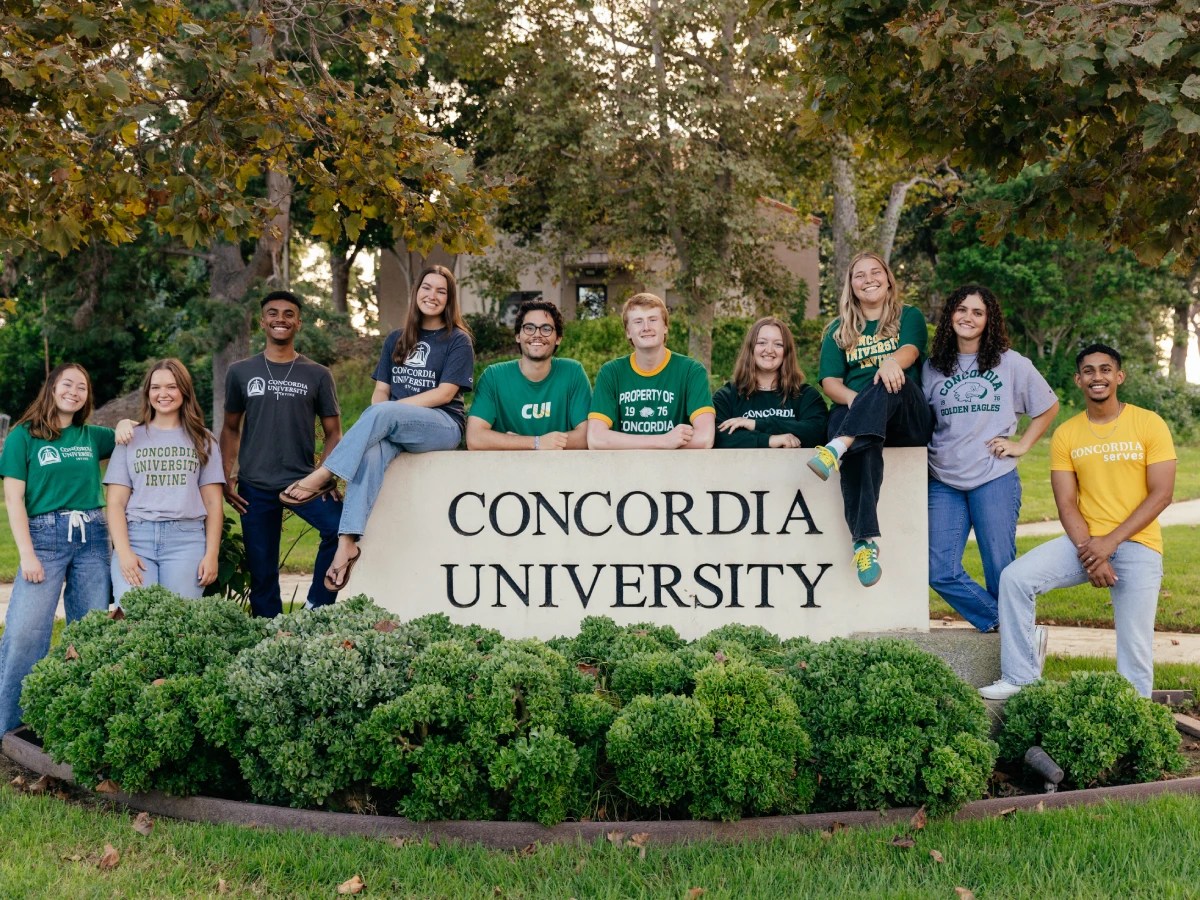
Join a community where you’re free to explore your interests and pursuits, make relationships that last a lifetime, and develop your own relationship with God. What will you explore?

Explore Financial Aid
Reduce your tuition costs with financial aid — with help from a team that wants to make your time at Concordia as affordable as possible.
Meet Our Faculty


FAQs
Are math majors in high demand?
Yes! From 2024 to 2034, mathematical science occupations are projected to grow much faster than the average for all occupations. Fields like data science and actuarial analysis continue to experience especially high demand.1
What do you call someone with a math degree?
Graduates with a math degree are usually referred to as mathematicians. Mathematicians work in a range of fields, however, and may become analysts or researchers — professionals who use data and reasoning to solve real-world problems. Whether you work in finance, education, or technology, you’ll be part of a field that values curiosity and precision.
Can math majors find jobs?
Absolutely. Math majors have one of the highest employment rates among college graduates, with opportunities in data analytics, education, research, and business. California is home to some of the top employers of mathematical professionals in the nation.1
Related Programs
-

Psychology
Study the mind and explore human behavior with a psychology…
-

Music
Develop your musical talent and inspire others with a music…
-

Liberal Arts
Prepare for all of your life’s callings with a liberal…
-

History and Political Thought
Learn from the past to lead with understanding and purpose.
-

Graphic Design
Become a strategic, visual storyteller as a graphic design major.
-

English
Learn to think deeply and write clearly with an English…
-

Engineering
Imagine, innovate, and create with an engineering degree.
-

Digital Media Studies
Become a responsible, dynamic communicator in today’s digital age.
-

Data Science
Solve real-world challenges with math, computer science, and data.
-
Communication Studies
Major in communications and make your message matter.
Sources
1U.S. Bureau of Labor Statistics, U.S. Department of Labor, on the internet, at:
- https://www.bls.gov/ooh/math/ (viewed Oct. 26, 2025),
- https://www.bls.gov/ooh/math/actuaries.htm (viewed Oct. 26, 2025),
- https://www.bls.gov/ooh/math/data-scientists.htm (viewed Oct. 26, 2025),
- https://www.bls.gov/ooh/math/mathematicians-and-statisticians.htm (viewed Oct. 26, 2025),
- https://www.bls.gov/ooh/math/operations-research-analysts.htm (viewed Oct. 26, 2025),
- https://www.bls.gov/ooh/business-and-financial/financial-analysts.htm (viewed Oct. 26, 2025),
- https://www.bls.gov/ooh/computer-and-information-technology/software-developers.htm (viewed Oct. 26, 2025),
- https://www.bls.gov/ooh/field-of-degree/mathematics/mathematics-field-of-degree.htm (viewed Jan. 17, 2025),
- https://www.bls.gov/oes/current/oes152021.htm#st (viewed Jan. 17, 2025).
Cited projections may not reflect local and/or short-term economic or job conditions and do not guarantee actual job growth.