



Bachelor of Arts in Economics
Gain new perspectives and expertise as an economics major.
Get Started Today
Ready to learn more about Concordia University Irvine?
Complete this form, and an admissions counselor will connect with you.
"*" indicates required fields
Respond to Consumer Trends and Expectations
Develop a deep understanding of economics and how it impacts the world with a bachelor of economics from Concordia University Irvine.
Economics is the study of human behavior and how societies make decisions about limited resources. It examines how different economic systems shape communities, institutions, and markets, as well as the outcomes of those choices, from public policy to shared prosperity. While the field of economics includes strong quantitative analysis, it is ultimately rooted in understanding people, values, and impact.
The economics degree program covers topics such as macroeconomics, microeconomics, business data analytics, morality and social policy, and finance. You will learn how to apply economic principles to contemporary issues such as international trade, financial markets, and government policies and experience practical, hands-on learning.
Career Relevant
Gain real-world skills for a life of service and leadership.
Collaborative Classes
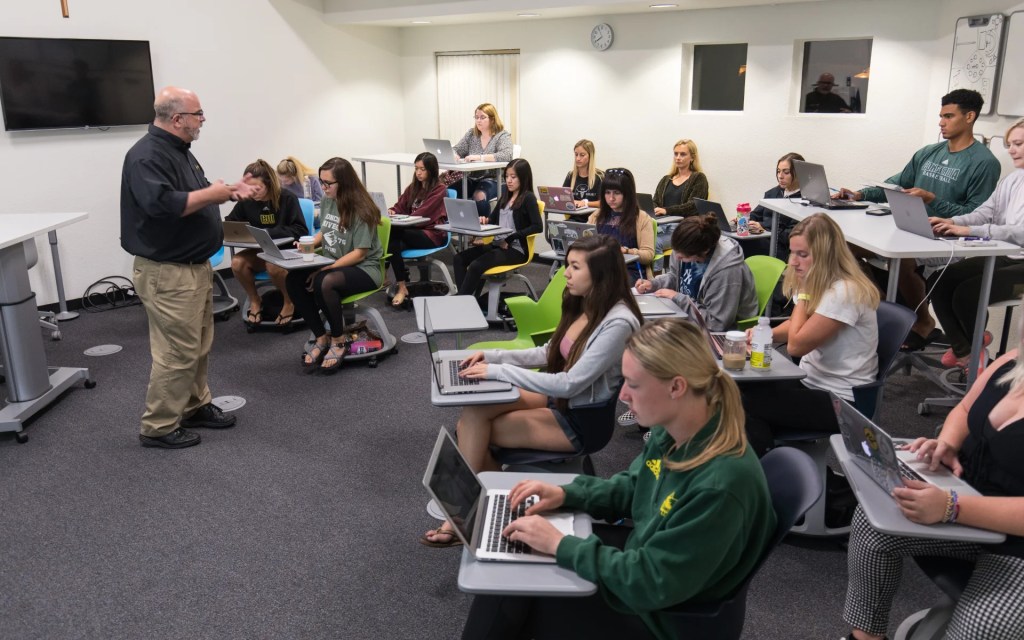
Learn in classes with a 15:1 student-to-faculty ratio.
Caring Community
Discover your second home on our beautiful campus.


“Concordia’s small class size creates an environment that fosters more intimate relationships where I see the professors value the investment in the work I produced.”
Devin Grimalda ’15
Getting Started
As an economics major at Concordia, you will explore tools like econometrics and clustering techniques. The skills you will learn are valuable in a variety of markets, like analytics, data science, and marketing.
Courses cover topics in efficiency, ethics, human behavior, psychology, and people skills. You will benefit from direct and consistent support from your professors. There are 14 required courses, and you can choose your final three classes from a number of options. At the end of your economics degree program, you will take your thesis course, in which you will integrate and apply key economic theory and models through your choice of research.
Next Start
January 11, 2027
Curriculum
Complete ALL of the following Courses:
- ACT211 – Financial Accounting
- BDA337 – Introduction to Business Data Analytics
- BUS201 – Introduction to Management, Marketing and Information Technology
- BUS261 – Business Analysis Tools and Business Statistics
- BUS483 – Business Ethics
- ECO201 – Macroeconomics
- ECO202 – Microeconomics
- ECO221 – History of Economic Thought
- ECO321 – Econometrics
- ECO421 – Intermediate Microeconomics
- ECO428 – Intermediate Macroeconomics and Public Policy
- ECO485 – Economic Major Thesis
- FIN331 – Finance
- MTH252 – Introduction to Calculus
View the Concordia University Irvine Online Catalog for a full list of courses.
With an economics degree, you will be able to:
- Explain the major theoretical concepts of economics.
- Evaluate the relationship between legal, social, and economic environments.
- Describe the global economic environment.
- Describe and explain the ethical obligations and responsibilities of economics.
- Apply modeling and decision-supporting tools to economic decision making.
- Construct and present effective oral and written forms of professional communication.
- Apply knowledge of economic concepts and functions in an integrated manner.
Tuition and Fees
At Concordia, we understand that investing in your education is a significant decision. That’s why we offer a variety of scholarships and financial aid options to help make your academic journey more affordable. In fact, 100% of our students receive some form of financial assistance! View tuition costs and fees for undergraduate programs.
Admission Requirements
View the Concordia University Irvine Online Catalog for full details on application and admission requirements.
Nationally Recognized Q&I Curriculum
Concordia University Irvine is among a distinctive group of universities that offer a comprehensive liberal arts curriculum for all of its students. Our nationally recognized Enduring Questions & Ideas curriculum (Q&I, for short) is carefully crafted so that you discover the purpose of a liberal arts education — to grow intellectually, ethically, and spiritually.


Career Outcomes
While economists make up a small part of the job market, they are some of the highest earners among business degree holders.1 Employment of economists is projected to grow 5% from 2023 to 2033, which comes out to about 1,000 openings each year, on average, over the decade.2
Common career paths for economics majors include:
- Finance
- Consultancy
- Economics — micro, macro, and global
- Accounting
- Investments
- Financial Analyst
- Portfolio Management
- Market Research Analyst
- Policy Analyst
- Financial planning
- Legal monetary advisor
Academic Opportunities
As an economics major, you can augment your studies with a related minor, another major (dual major), or a pre-professional program.
Extracurricular Activities
The School of Business and Economics offers many opportunities for you to become involved with on-campus events, clubs, and organizations. Many of our economics majors also participate in our nationally ranked Forensics Team – applying the critical thinking skills they learn in the classroom to argumentation and debate in competition.
- Concordia Business Challenge
- Enactus
- International Business Club
- Sports Business Club
- Women in Business
- Sigma Beta Delta (Honors society)
- Concordia Investment Group
- Delta Sigma Pi Business Fraternity
Life at Concordia
Join a community where you’re free to explore your interests and pursuits, make relationships that last a lifetime, and develop your own relationship with God. What will you explore?

Explore Financial Aid
Reduce your tuition costs with financial aid — with help from a team that wants to make your time at Concordia as affordable as possible.
Meet Our Faculty
-

Laszlo Zoltany
Adjunct Professor, School of Business Contact Email: Email Laszlo Zoltany…



FAQs
Is an economics degree worth it?
If economics is an area of study you want to dive into, then, yes, becoming an economics major would definitely be worth it.
Where can I work with an economics degree?
In 2023, the largest employers of economists were1:
- Federal government, excluding postal service: 28%
- Management, scientific, and technical consulting services: 16%
- State government, excluding education and hospitals: 13%
- Scientific research and development services: 9%
- Local government, excluding education and hospitals: 8%
Is economics a lot of math?
There is some math involved in an economics degree, but it’s not as much as you may think. At Concordia, some of the courses include Business Analysis Tools and Business Statistics, Econometrics, and Introduction to Calculus.
Related Programs
-

Sports Business – BA
Prepare for a winning career with a sports business degree.
-
Pre-Business Program
Realize your potential by entering the Pre-Business Program.
-

Business Administration – BA
Thrive in the global marketplace with a business administration degree.
-

Marketing
Strategize to help organizations win with a minor in marketing.
-

Managerial Science – MBA
Grow as a strategic manager in business and STEM-driven industries.
-

Sports Business – Minor
Develop a winning skill set with a minor in sports…
-

Sports Business – MBA
Elevate your sports industry expertise with a master’s in sports…
-

Business Administration – MBA
Prepare for leadership or entrepreneurship with our MBA degree program.
-

Economics – Minor
Understand the choices that move markets with an econ minor.
-

Business Minor
Get introduced to the business world with a well-rounded minor.
Sources
1Highest-Paying College Majors: 2025 Statistics, Best Colleges, on the internet, at https://www.bestcolleges.com/research/highest-paying-college-majors/#highest-paying-business-majors (viewed Feb. 3, 2026).
2U.S. Bureau of Labor Statistics, U.S. Department of Labor, on the internet, at https://www.bls.gov/ooh/life-physical-and-social-science/economists.htm (viewed Nov. 8, 2024).
Cited projections may not reflect local and/or short-term economic or job conditions and do not guarantee actual job growth.