



This article is part of the series “From AI Skeptic to AI Champion,” which explores how educators can move from fear and uncertainty toward wise, ethical, and human-centered AI adoption.
One teacher leaves an AI workshop energized and begins using it the next day. Another leaves overwhelmed and never opens the tool again. A third waits until a colleague shows her how AI can save thirty minutes of grading preparation. Why do teachers respond so differently to the same technology?
If schools want teachers to adopt Generative AI wisely, they will need more than a list of approved tools. They will need more than a one-hour professional development session. They will need more than a policy. AI adoption is not primarily a technology problem. It is a human problem. Teachers do not adopt new practices simply because someone tells them to. They adopt when they believe the practice is useful, when they feel capable of doing it, when trusted colleagues are also doing it, when their school provides support, and when the practice resonates with who they are called to be as educators.
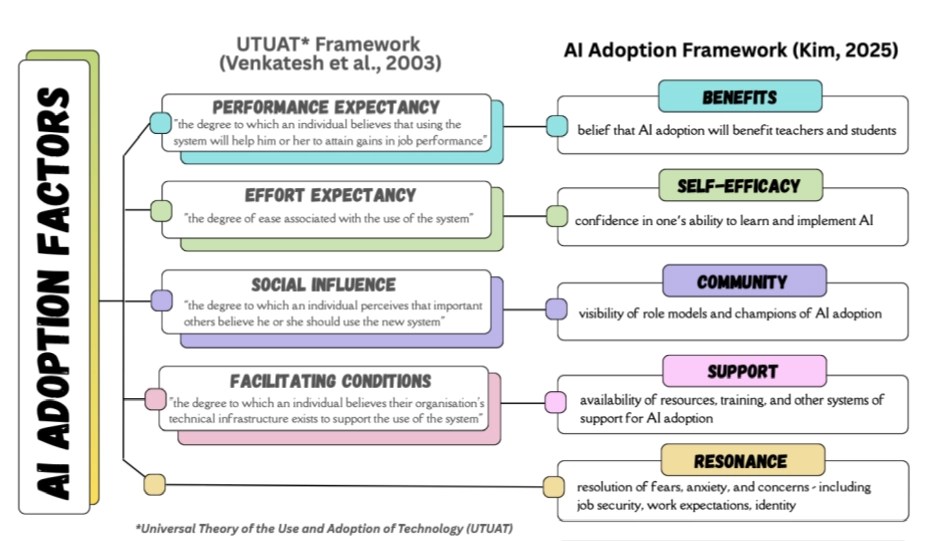
The Unified Theory of Acceptance and Use of Technology (UTAUT) emphasized several predictors of technology use, including performance expectancy, effort expectancy, social influence, and facilitating conditions (Venkatesh et al., 2003). People are more likely to use technology when they believe it will help them, when they believe they can use it, when colleagues support its use, and when the organization provides the conditions needed for success.
For education, and especially for AI adoption, I find it helpful to translate these ideas into five AI Adoption Factors: benefit, self-efficacy, community, support, and resonance. These factors help explain why some teachers move from curiosity to practice while others remain hesitant, overwhelmed, or unconvinced.
Benefit: Will AI Actually Help Me?
The first factor is benefit. In UTAUT, this is similar to performance expectancy: the belief that using a technology will improve one’s work or performance (Venkatesh et al., 2003). For teachers, the question is straightforward: Will this actually help me teach?
Teachers are practical people. They live in the world of lesson plans, grading, parent emails, student questions, classroom interruptions, meetings, accommodations, behavior concerns, and unfinished tasks. They do not need another shiny tool that makes big promises and then creates more work. If AI is presented only as the future, many teachers will nod politely and return to what already feels urgent. But when teachers experience AI as genuinely useful, their posture often changes.
AI can help generate lesson ideas, create rubrics, draft parent communication, differentiate reading passages, produce multiple-choice questions, suggest project ideas, summarize complex texts, translate materials, create examples and non-examples, and offer feedback. None of these uses removes the teacher’s judgment. But they can help a teacher move from a blank page to a workable draft. Many teachers are exhausted. If AI is experienced as one more obligation, adoption will be shallow. If AI is experienced as a tool that gives time back for the work teachers care about most, adoption becomes more meaningful.
The benefit of AI should not be framed only as efficiency. Efficiency alone is too small a vision. The better question is what teachers can do with the time and energy AI helps recover. Can they spend more time with students? Can they give better feedback? Can they design more creative learning experiences? Can they differentiate more effectively? Can they focus more on relationships, mentoring, and formation? The key leadership question is: Have we shown teachers how AI can help with work they already value? If not, we should not be surprised when teachers resist.
Self-Efficacy: Can I Do This?
The second factor is self-efficacy. In UTAUT, this connects closely to effort expectancy, or the perceived ease of use of a technology (Venkatesh et al., 2003). But for teachers, the issue is not only whether AI is easy. The deeper issue is whether they believe they can use it successfully.
Many teachers have lived through failed technology rollouts. They have seen devices distributed without training, platforms adopted without purpose, software abandoned after one year, and systems that promised to save time but actually consumed more of it. So when AI arrives, some teachers understandably think, “here we go again.”
Teachers need to believe, I can learn this. They need early experiences that are low-risk, useful, and successful. They need to see that AI does not require them to become computer scientists. They need permission to begin small. This is the importance of the AI Novice stage. Before asking teachers to redesign assignments or guide students in AI use, we should give them space to experiment. Ask AI to create five discussion questions. Ask it to simplify directions. Ask it to draft a parent email. Ask it to revise a rubric. Ask it to generate an analogy for a difficult concept. Then evaluate the result. What was helpful? What was wrong? What needed revision? What would you never use? What surprised you?
This kind of practice builds confidence because teachers discover that AI is neither magic nor nonsense. It is a tool. It works better when guided well. It makes mistakes. It requires judgment. It can help. Self-efficacy grows through use, not merely explanation. This also means professional development should not be mostly lecture. Teachers need hands-on time. They need examples. They need prompts. They need coaching. They need to see someone model the process imperfectly. They need to know that it is acceptable to try something and get a mediocre output. The key leadership question is: Have we made AI feel learnable? If teachers feel embarrassed, judged, or overwhelmed, they will retreat. If they feel capable, supported, and safe to practice, they will grow.
Community: Are People Like Me Using This?
The third factor is community. In UTAUT, this is related to social influence: the degree to which people perceive that important others believe they should use a technology (Venkatesh et al., 2003). In schools, however, this is not only about pressure from leaders. It is about trust.
Teachers are often most influenced by other teachers. A keynote speaker can inspire. An outside consultant can provide helpful frameworks. A principal can set direction. But sometimes the most persuasive voice is the teacher down the hall who says, I tried this with my students, and here is what happened. Teachers want to know whether people like them are using AI. A kindergarten teacher wants to hear from another early childhood educator. A high school English teacher wants to know how another English teacher is handling writing. A math teacher wants examples that make sense in math. A special education teacher wants to know how AI might support accommodations, differentiation, or communication.
Community makes adoption concrete. It also reduces fear. Teachers who experiment alone may feel uncertain. Teachers who experiment together can ask better questions: What worked? What failed? What did students do? What surprised you? What would you change next time? What boundaries did you set? What did parents ask? How did you handle disclosure? This is why AI Champions matter. An AI Champion is not simply someone who knows the most. An AI Champion is someone willing to model, mentor, and encourage others. Champions help create a culture where teachers can be honest about both successes and failures.
Schools should consider building communities of practice around AI. These do not need to be complicated. They might include short faculty demonstrations, department sharing, grade-level experiments, prompt libraries, peer coaching, or monthly what we tried conversations. The key leadership question is: Have we made AI adoption social rather than solitary? Teachers are more likely to adopt AI when they are not adopting alone.
Support: Will My School Help Me Do This Responsibly?
The fourth factor is support. In UTAUT, this is related to facilitating conditions: the degree to which people believe an organizational and technical infrastructure exists to support use of the technology (Venkatesh et al., 2003). For schools, this is essential.
Teachers cannot be expected to adopt AI responsibly if schools do not provide responsible conditions. Support includes time, training, approved tools, policy guidance, privacy review, parent communication, technical access, examples of appropriate use, and administrative clarity. Without these, AI adoption becomes uneven and risky. Some teachers will race ahead. Others will do nothing. Students will receive mixed messages. Parents will become confused. Academic integrity expectations will vary from classroom to classroom. Teachers may feel exposed if they try something and it goes poorly. Support creates wise boundaries.
Teachers need answers to practical questions: Which tools are approved? Can students use AI? At what grade levels? For what kinds of assignments? What must students disclose? What counts as misuse? What should teachers do when they suspect misuse? What student data should never be entered into AI? How should parents be informed? How do we protect equity of access? What professional development will be ongoing? These questions are not obstacles. They are the work.
Support becomes especially important as teachers move from Stage 2 to Stage 3 or Stage 4 of AI adoption. When a teacher privately uses AI to draft a lesson plan, the risk is relatively low. When teachers begin using AI to evaluate student work, generate feedback, or design direct student-AI interactions, the risk increases. Teachers need clear guidance and administrative backing. The key leadership question is: Have we created the conditions for wise AI use? If schools want responsible adoption, they must provide responsible support.
Resonance: Does This Fit Who I Am as a Teacher?
The fifth factor is resonance. This factor is not always emphasized in traditional technology adoption models, but I believe it is essential for education. Teachers do not adopt practices only because they are efficient or easy. They adopt practices that fit their identity, values, purpose, and vocation. This is especially true with AI.
Some teachers worry that AI will make learning less human. Others worry that it will weaken student thinking. Others fear it will increase cheating, reduce creativity, automate feedback, flatten writing, or turn teaching into content management. Many listen to rumors of AI replacing their jobs as teachers. These concerns should not be dismissed. They are not merely technical concerns. They are vocational concerns.
Teachers are asking, often beneath the surface: Does this help me become the kind of teacher I am called to be? If AI feels like a violation of the teacher’s deepest commitments, adoption will remain reluctant and superficial. But if AI can be connected to those commitments, adoption becomes more meaningful.
For the teacher who values relationships, AI can be framed as a tool that reduces repetitive work so there is more time for students. For the teacher who values critical thinking, AI can be framed as an object of critique, evaluation, and discernment. For the teacher who values equity, AI can be framed as a tool for differentiation and access, while still requiring careful attention to bias. For the teacher who values student formation, AI can be framed as an opportunity to teach honesty, wisdom, responsibility, and self-control. For the teacher in a faith-based school, AI adoption can be framed around stewardship, vocation, truth, service, and love of neighbor.
We should not ask teachers merely to become more efficient. Efficiency is useful, but it is not the highest good. The higher goal is faithfulness. AI should not be adopted because it is impressive. It should be adopted where it helps us serve students better. The key leadership question is: Have we connected AI use to teachers’ deeper purpose? Without resonance, AI adoption becomes compliance. With resonance, it becomes faithfulness to purpose.
Adoption Is More Than Access
These five factors help explain why AI adoption varies so widely among educators. A teacher may see the benefit but lack confidence. A teacher may feel confident but lack school support. A teacher may have support but no community. A teacher may have access to tools but see no connection to the heart of teaching. A teacher may be curious but unsure whether AI use is ethically or pedagogically appropriate. This is why schools must think beyond tools.
If we want teachers to adopt AI wisely, we must attend to the human conditions of adoption: benefit, self-efficacy, community, support, and resonance. When these factors are present, teachers are more likely to move from skepticism to exploration, from exploration to practice, and from practice to leadership. When these factors are absent, adoption will either stall or become careless.
Generative AI is too powerful to ignore and too risky to adopt thoughtlessly. Teachers need a path forward that is practical, ethical, communal, and deeply human. They need more than permission to use AI. They need trust, confidence, support, community, and resonance.
References
Davis, F. D. (1989). Perceived usefulness, perceived ease of use, and user acceptance of information technology. MIS Quarterly, 13(3), 319-340. https://doi.org/10.2307/249008
Kinnen, M. (2024). AI learning framework. Unpublished framework.
Venkatesh, V., Morris, M. G., Davis, G. B., & Davis, F. D. (2003). User acceptance of information technology: Toward a unified view. MIS Quarterly, 27(3), 425-478. https://doi.org/10.2307/30036540
Eugene P. Kim, PhD
Faculty, Ed.D. in Leadership Program
Dr. Eugene P. Kim started at Concordia University Irvine in 2007 as Dean of Asia Programs, responsible for the strategic planning of the university’s Asia strategy, and Founding Director of the MA in International Studies (MAIS) programs in International Education, International Development, and International Business. From 2007–2017, Dr. Kim was deployed to Shanghai, China and represented the university’s interests in China and Asia. During that time he established MOUs and partnerships with over 20 Chinese universities and schools in Shanghai, Hangzhou, Beijing, Kunming, and other cities; developed graduate programs with over 300 alumni and $1.5 million in annual revenues; implemented short-term immersive study abroad programs for undergraduate and graduate students to China; successfully fundraised for an Asia library; and designed marketing materials, promotions, and university branding in China.
Read More
Currently (since 2017) Dr. Kim serves as faculty in the Ed.D. in Leadership program, mentoring dissertation students in K-12, higher education, non-profits, and business sectors. His current research interests align with those of his doctoral students, including under-represented minority access to STEM, internationalization of education, educational entrepreneurship and innovation, and gratitude interventions.
Prior to this, Dr. Kim was a tenure-track professor at Pepperdine University where he taught graduate level teacher education courses and was the founding coordinator of a professional development school in Hollywood. During his tenure at Pepperdine University, he served as chair of the Pepperdine Charter School Initiative, as advisor to doctoral students of educational leadership, and as a member on the Rank, Tenure, and Promotion Committee.
Dr. Kim has served on boards of foundations and universities (Harvey Fellows, Emperor’s College), founded several non-profits and private companies (House for Kids, Foundation for Transformational Leadership, Xiamen Concordia International School, Integrated Education, Ltd., Kennedy Group, Ltd.), and is consultant to diverse industries including foreign investment, Hollywood films, and executive leadership.
Faculty, Ed.D. in Leadership Program
Dr. Eugene P. Kim started at Concordia University Irvine in 2007 as Dean of Asia Programs, responsible for the strategic planning of the university’s Asia strategy, and Founding Director of the MA in International Studies (MAIS) programs in International Education, International Development, and International Business. From 2007–2017, Dr. Kim was deployed to Shanghai, China and represented the university’s interests in China and Asia. During that time he established MOUs and partnerships with over 20 Chinese universities and schools in Shanghai, Hangzhou, Beijing, Kunming, and other cities; developed graduate programs with over 300 alumni and $1.5 million in annual revenues; implemented short-term immersive study abroad programs for undergraduate and graduate students to China; successfully fundraised for an Asia library; and designed marketing materials, promotions, and university branding in China.