


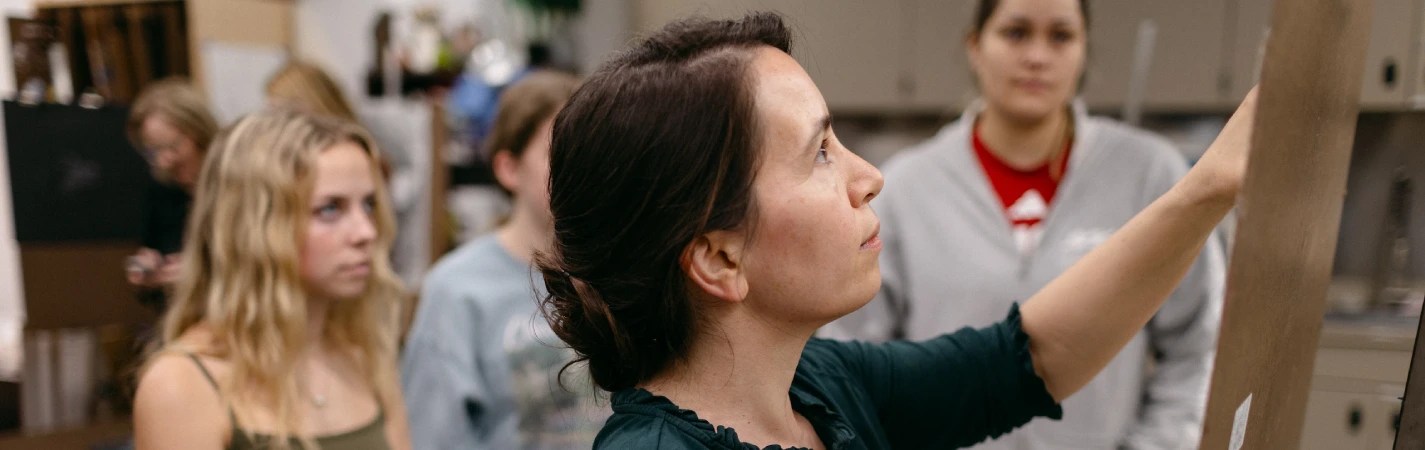
Four Concordia professors from widely different fields traveled to Concordia Theological Seminary in Ft. Wayne last fall to speak at the Lutheranism and the Classics conference, presenting on subjects as varied as the origin of modern biological taxonomy to how pastors can teach parishioners to appreciate works of art. In so doing, Concordia University Irvine demonstrated the unique interdisciplinary community it cultivates on its own campus.
“The fact that we brought an artist and a biologist to a classics conference at the Ft. Wayne Seminary is unheard of,” says Daniel Deen ’21, professor of philosophy. “Biology professor Sarah Karam ’04 was the only scientist there. Art professor Sara Fletcher was the only artist there. Irvine’s faculty are special in that we regularly engage in interdisciplinary dialogue. It’s part of the Concordia ethos.”
The bi-annual conference drew Lutheran educators and ministers from around the country and was also attended by classical K-12 education leaders. C.J. Armstrong, a self-described “Latinist” steeped in the classics — which he describes as a field of humanistic learning focused on the civilizations, languages, literature and philosophy of the ancient Mediterranean between 3,000 B.C. and 500 A.D. — has presented papers at many of these conferences, and this year he decided to rally his friends and fellow faculty members to create cross-topical dialogues from their areas of expertise.
“I have great colleagues at Concordia who aren’t classicists but do classical liberal arts education here,” Armstrong says. “I’ve learned so much from Sarah Karam as a biologist, Sara Fletcher as a practicing artist and professor of art, and Dan Deen and my other philosopher friends. They are well-read, deep thinkers as well as brothers and sisters in Christ. So this year I said, why don’t we invade the conference? To have scientists, artists, philosophers, practitioners and thinkers all looking at topics from our various disciplines is the best way to break down barriers and expand our learning.”
The result, he says, was “very gratifying” and well represented Concordia’s academic culture.
Sara Fletcher, in her fourth year at Concordia and hailing originally from Chautauqua, New York, teaches studio art, drawing and figure sculpture in Irvine. When starting her Ft. Wayne presentation, she looked out “into that sea of white collars and thought, ‘Oh, no. They’re going to find out that the artist should not have come to the Lutheranism and the Classics conference,’” she says with a laugh.
But her apprehensions were premature. She showed three works of art and two student works to a packed room.
“I was trying to take a baby step toward defining beauty by illustrating the idea of plasticity in art, which is the best word I have for something that transforms,” Fletcher says.
Using the 6th-century wood-painted icon, Christ Pantocrator, which shows Jesus with two fingers up in blessing, she led the audience in a simple foreground-background reversal showing that art can change as you look at it. She also made sense of Old Testament allusions and spatial and geometric relationships between objects depicted in various paintings which were done intentionally to convey theological connections.
For example, in a 1555 painting for a church in Weimar, Moses’ tablets are parallel to the line of the spear Christ is aiming at Satan. The Gospel is literally in line with the law.
My hope was to say, “It’s okay to look at art. Art is a gift we haven’t accessed for a while. Art logically opens up so you can grasp it visually and connect it to theology.”
She was pleasantly surprised at how many people came up afterwards to offer thanks, ask questions and even request a kids’ curriculum based on her ideas. The church, she believes, could benefit from rediscovering the joy that art’s beauty can offer.
“If pastors were empowered to teach congregations how to understand art, we might satisfy that desire for change that we try to satisfy by doom-scrolling,” says Fletcher. “Art can be a helpmate to faith. Receptivity to beauty may well be an analogy for receptivity to grace.”
In another session, Karam, professor of biology and co-chair of the natural sciences department, presented a paper on Carl Linnaeus, a Swedish Lutheran and father of modern taxonomy (the classification system using genus, species, phylum, etc.). But her interest was in Linnaeus’ manner of thinking about classification, a subject she also tackles in her classes at Concordia.
“We talk often about how to live as a scientist and a Christian,” Karam says. “At the conference I was looking at how we came to this understanding of how humans fit into the order today. Who are we relative to the rest of nature, and what are we supposed to do about it? Are we exceptional and over other creatures or are we just one of many? It has implications for how we treat all living things, what our role in the world is and what it means to have dominion — to be very good versus just good.”
Linnaeus, she told the gathering, “preserves aspects of set-apartness — made in the image of God, our uniqueness and thinking — and simultaneously, like Aristotle, says we still need to eat and sleep and have ecological dependencies.” She also noted that Linnaeus received a classical education and became “a novel scientific thinker.”
It was unusual for her to present at this particular forum.
“This certainly was an audience outside my usual wheelhouse,” she says, “but I found it immediately interesting as an opportunity to augment what we’ve already been doing here in Irvine and bring it to a new audience.
Sometimes we all build our own little bubbles. The common stereotype is that it’s the humanities or the sciences — but that doesn’t really work. What we’re doing is a human endeavor and a way of knowing what it means to live and be human in relation to each other and to God. It’s not separate or distinct.”
Dan Deen in his presentation illuminated a Martin Luther-era controversy over how to study great works of philosophy and theology: through the commentaries of others or using primary sources? He asked his audience, “In our day, what are we seeking to progress from and what are we seeking to conserve?”
Interdisciplinary dialogue creates critical thinkers who adapt well when things don’t go exactly as planned in each discipline’s discrete area, Deen believes.
“Life never works perfectly,” he says. “The humanities are a huge help in getting us to think of things differently. When the structures that are supposed to be perfect fail, that is where the liberal arts thrive. It allows you to say, ‘I don’t have to give up. I have the tools in the human mind, soul and ability to reason and put things back together.’”
“Our presence there showed that here at Irvine you’re not going to be put into a box as a student,” he says. “It would be so much easier to just teach philosophy classes and not have to think about what’s going on in biology, mathematics, art, or theology. But at Irvine we’ve created a culture where professors are engaging with each other at the interdisciplinary level to have conversations which build trust. We ask each other, what is the relationship between the biological sciences and art? Or theology, philosophy, and art? We have this mindset that philosophy can’t be done in a vacuum, nor can science, theology, or art. We might not have perfect answers, but we are consistently engaging in and thinking about it.”
The shared commitment to faith among those in attendance allowed the dialogues to be even richer, says Karam.
“Everybody was deeply committed to a foundational understanding of who we are in relationship to our God and also to vocation and a holistic approach to considering our fellow humans,” she says. “That made it easy to have these conversations with trust already there. It was wonderful.”
Armstrong, who also is ordained in The Lutheran Church—Missouri Synod and serves as a pastor, presented on the classical references in Luther’s “Bondage of the Will,” which celebrates its 500th anniversary this year. But he was most pleased that he was able to take his colleagues to the conference as ambassadors of the kind of culture professors and students enjoy at Concordia University Irvine.
As Deen puts it, “It’s kind of crazy, but somehow at Irvine we have the right mix of people. That’s pretty amazing.”