


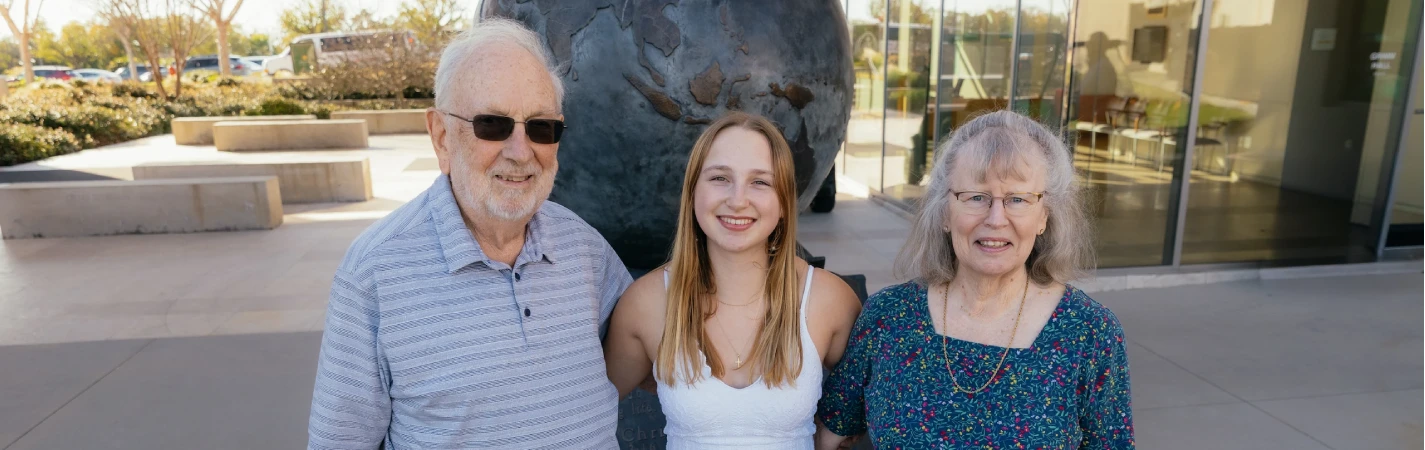
Fred and Patricia “Trisha” Gebhardt share a long history in the Lutheran church and a passion to support the future of Lutheran education. Their faithful giving on a monthly basis, to special projects at Concordia University Irvine such as nursing students, parochial school teachers, ministry students, and the Golden Eagle Athletics Complex and with the generous designated donation of their home in their trust, demonstrates they are carrying on the legacy of ministry and ministry support handed to them by their forebears.
“The Lord has blessed us to be able to give,” said Fred, who recently turned 90.
Fred was born in China to a Lutheran Church—Missouri Synod missionary father who had arrived there in 1918 straight out of St. Louis seminary, and to his mother who arrived with her sister in 1923 to serve as a nurse at an orphanage and as a teacher in the school.
“The story went that they had a missionary at my mother’s family’s church in Nebraska who preached one Sunday morning and said, ‘We need people to go to China,’” Fred says. “My grandfather, who was the pastor, asked at the dinner table, ‘Who’s going to go?’ My mother and aunt said they would.”
As two single women who didn’t know the language (though both spoke German and English) they set out by train to Seattle, by boat to Shanghai, by boat up the Yangtze River, and by sedan chairs carried over the mountains to Enshih, China. In this pre-communist China, tradition ruled, women had bound feet and the two American women sometimes slept in pig pens on the way to their destination.
Fred’s parents met and married there, had two children, one of them Fred, then returned to the United States when Fred was 10 months old.
“The crisis with the Japanese taking over most of China was happening at the time,” says Fred. “My parents came back on furlough but didn’t go back because of that crisis.”
As he grew up, he heard his mother share stories about Mao Zedong’s army coming over mountains and setting up cannons at the missionary complex overlooking the city, but they had left the gunpowder for the cannons three days’ journey over the mountains.
The family moved to St. Louis, then Neosho, Missouri, where his father was a pastor near Camp Crowder. Then his father’s pastoral career took them to Iowa and finally a little country church in Nebraska, an area Fred liked especially.
“It was a country atmosphere out there and a nice place to grow up,” Fred says.
As a young man he worked on the farm of a hybrid corn company, taking care of the animals and de-tasseling corn. But his own interests ran to civil engineering, a subject he studied at the University of Nebraska before moving to Los Angeles to take a job at the Los Angeles County Flood Control District in 1959.
“I didn’t know the difference between San Francisco and Los Angeles,” he says. “I stayed in a hotel downtown until some friends I met at Emmaus First Lutheran Church in Alhambra found an apartment and then, later, a house for me in Rosemead.”
He met a nice girl at choir practice at Emmaus and married her. In 27 years of marriage they raised three children together, Katherine, Philip, and Mark. His wife went to be with the Lord in 1992, leaving Fred a widower for four years.
“Someone asked me at the reception after the funeral what I was planning to do next,” he says. Spontaneously, Fred replied, “Maybe I’ll go to Fuller Seminary.”
That fall he enrolled at Fuller for a class on the Pentateuch and “we went through the whole Bible that way,” he says. In six years he had earned his masters in theology degree.
“Someone said the reason I went was because it was a grieving process, and maybe it was, but I don’t recall thinking about it before the funeral,” he says.
That education would help set the course for his future ministry. Meanwhile, Trisha’s former pastor, Maynard Saeger, and his wife thought they detected a match for Trisha in Fred.
“He wanted to know if I would be interested in meeting a nice Lutheran guy whose wife had passed away. I agreed and he gave Fred my phone number,” Trisha says.
The Saegers stopped by Fred’s house when he was out pulling weeds in the front yard one day and inquired, “Do you want to meet a nice Christian woman?” Fred replied, “Why not?”
Trisha was a native Californian, born in Pomona. Her ancestors had come from Germany and two of them helped start the historic LCMS community in Perry County, Missouri, in the 1830s.
As a girl, Trisha attended St. Paul’s Lutheran School in Pomona, then graduated from Montclair High School and worked for the City of Upland while earning her BA in public administration. Her municipal career began at the library then went to the water department where she eventually became assistant to the water utilities director.
Dining together and finding they had much in common. Trisha says now, “We felt like God had put us together because of both of our circumstances, being Lutheran and working in the field of water utilities. It worked out, and we were very happy.”
They were married in September 1996 and moved to Irvine. Soon after that, one of Fred’s seminary professors announced there was a retirement home needing a pastor. Fred, intrigued, talked with Trisha about it and they agreed to take the position. For 20 years they held volunteer church services on Sunday afternoons in a retirement home in Newport Beach.
“I never saw myself being a pastor,” Fred says. Neither did he see himself being a church-planter until he ran into old friends from Senior Walther League days while shopping for Christmas gifts one year. Their names were Charles and Barbara Manske, and on the spot Charles asked him, “Would you like to go with us to Grand Cayman to start a Lutheran church?”
“Where’s Grand Cayman?” Fred said.
He and Trisha did journey there and spent a week leaving flyers at hotels and setting up a room for a first church service which drew about 50 people. To their knowledge, the church is still thriving.
Back in Irvine, the Gebhardts also began contributing to Concordia in a variety of ways. They started a scholarship fund in honor of Trisha’s mother and father, Dorris and Bernice Carls. They gave to special projects such as nursing training, parochial school teachers, pastors, the Borland-Manske Center, and the Golden Eagle Athletics Complex, and in their will they directed their house to be given to the University to fund scholarships for students who are becoming pastors, teachers or nurses. The couple also gives to Concordia on a monthly basis.
“My parents were not rich but they worked very hard for my brother and myself to go to Lutheran parochial schools,” Trisha says. “I wanted my parents’ legacy to do something meaningful, and Fred agreed. My parents had been good Lutherans, and we wanted to support Lutheran schools and the teaching at Concordia.”
“When we look back and see the hand of the Lord on all the things around us, we begin to realize we are just a small fraction of the people the Lord loves. He gave his Son for everyone!” Fred says. “We don’t always know what He’s going to do in the future, but we know His love passes all understanding.”
Fred’s daughter today works as a physician’s assistant for liver and pancreatic cancer patients at Kaiser hospital in Los Angeles. His two sons serve the entertainment industry, one as a sound director for television shows and now for football games, and the other manufacturing sets for theatres and other venues around the world.
Fred and Trisha traveled widely in Europe and on cruises until slowing down of late due to age. Both Trisha and Fred have taught Bible classes; Trisha for women at their church, and Fred having taught numerous classes. Both attend various Bible studies on a regular basis.
“Even more now in our later years, our purpose is to witness the Gospel to whoever comes into our lives,” Trisha says. “You don’t have to be a preacher to be able to talk to somebody about what Jesus means to you. You can be any kind of profession, wherever you go. Whatever we do, we want to be compassionate toward other people who haven’t had quite the lives that we’ve had.”